Executive Summary
A leading commercial bank in the Middle East, with operations across six Gulf states and over $45 billion in assets under management, faced mounting pressure from regulators, investors, and the board to demonstrate strong non-financial governance over non-financial data — particularly climate risk integration into core banking operations.
The bank selected SustainGRC to replace fragmented ESG tools, disconnected GRC platforms, and manual audit processes with a single source of truth. Within six months of deployment, the bank satisfied central bank supervisors on areas and satisfied central bank supervisors on three specific requirements it could not previously evidence.
The catalyst: Three questions that required a new approach
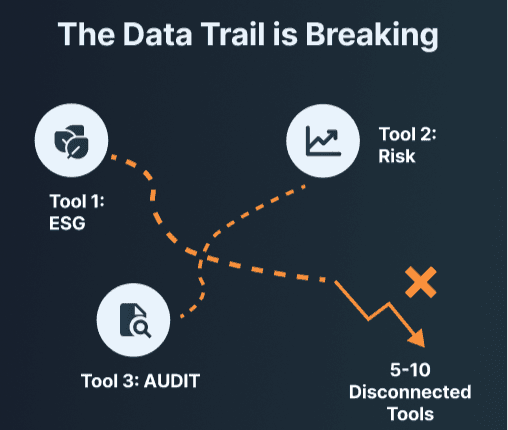
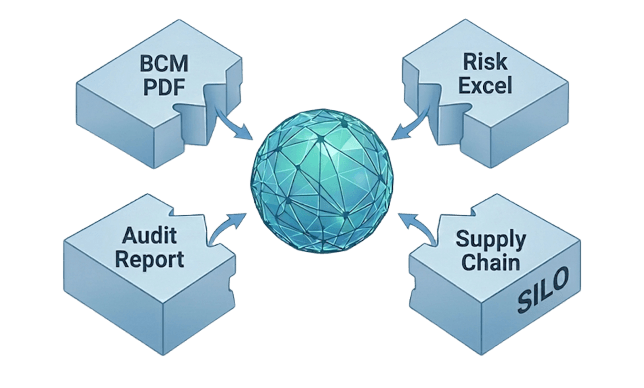
Like many financial institutions in the region, the bank had accumulated point solutions over several years. Each solved a narrow problem. None talked to each other. And critically, none could provide the evidence trail that regulators now demand.
Regulatory pressure intensified when central bank supervisors — aligning with Basel Committee principles and the region's emerging sustainable finance frameworks — requested evidence on three areas:
| Regulatory requirement | Feature asked for |
|---|---|
| 1. Financial emissions lineage | Auditability trail from borrower-level Scope 1, 2, and 3 data through portfolio aggregation to disclosure — with validation controls at every audit point |
| 2. Climate risk in credit decisioning | Documented controls showing how transition and physical risk factors fed into lending approvals, portfolio monitoring, and collateral valuation |
| 3. Evidence for external assurance | Complete audit trail with data lineage, timestamps, and control evidence — as required under emerging draft limited assurance requirements |
The bank's existing tools could not deliver on any of these.
Seven tools, zero integration
| Existing tool | Gap it created |
|---|---|
| Standalone carbon accounting (Scope 1 & 2 transition) | No link to lending portfolios — couldn't calculate financed emissions |
| Spreadsheet-based ESG data collection | No validation — 23 subsidiaries submitting unverified data with no audit trail |
| Legacy GRC platform (focused on IT risk) | Blind to climate risks — no integration with ESG or credit data |
| Manual internal audit workflows | No evidence capture — 6+ weeks to respond to regulator document requests |
| Separate supplier risk questionnaires | No linkage to Scope 3 — supply chain outside core governance |
"We had twenty years of infrastructure for financial data, but zero years for non-financial data. Every audit became a data archaeology exercise."
Why SustainGRC: Infrastructure, not another tool
After evaluating multiple vendors including established ESG platforms and GRC suites — the bank selected SustainGRC based on a fundamental differentiator: SustainGRC is governance infrastructure that embeds trust at the data layer, not a reporting tool that aggregates unverified data downstream.
Key Selection Criteria
| REQUIREMENT | SUSTAINGRC CAPABILITY |
|---|---|
| Data integrity at source | Real-time validation engine enforces controls before data enters the system |
| End-to-end audit trail | Complete lineage from source document to published disclosure — every transformation logged and timestamped |
| Multi-framework support | Single data capture supports ISSB, GRI, SASB, and central bank requirements |
| Evidence for assurance | Complete audit trail with data lineage, timestamps, and control evidence |
| ERM integration | Climate risk indicators embedded in enterprise risk framework |
| Supply chain governance | Integrated third-party risk and Scope 3 due diligence within core platform |
Implementation: Governed from day one
SustainGRC deployed a phased implementation plan over six months, prioritising the modules that would deliver immediate regulatory value whilst building the foundation for enterprise-wide governance. Each phase was designed to close risk gaps immediately.
Phase 1: Foundation (Months 1–2)
- Entity structure mapping across 23 subsidiaries and 6 jurisdictions
- Data governance policies and validation rules configured
- Control ownership assigned with clear accountability matrix
- Enterprise risk register migrated from legacy GRC system
Regulatory gap closed: Control ownership for entities established across all entities
Phase 2: Core modules (Months 2–4)
- ESG data collection and validation for GCC unified disclosures, ISSB, GRI, and central bank requirements
- Financed emissions methodology configured for Scope 3 and borrower data integration
- Internal audit planning and execution module deployed
- Climate risk indicators integrated with enterprise risk framework
Regulatory gap closed: Financed emissions lineage — complete trail from borrower data to portfolio disclosure
Phase 3: Optimisation (Months 4–6)
- Supply chain governance module for 200+ key vendors
- Board reporting dashboards with drill-down to source evidence
- Climate risk scores embedded in credit workflow and portfolio monitoring
- External assurance preparation and documenting methodology package automation
Regulatory gap closed: Climate risk in credit decisioning — transition risk integrated into lending approvals
Results: The three questions answered
Six months after go-live, central bank supervisors returned.
| Supervisory question | Bank's response |
|---|---|
| Financial emissions lineage | Complete Scope 1, 2, and 3 data across 23 subsidiaries — source to disclosure now auditable trail with validation controls tied to single source |
| Climate risk in credit decisioning | Physical and transition risk indicators now embedded in lending workflow, with documented controls linked quarterly and linked to portfolio monitoring |
| Assurance-ready evidence | First external assurance engagement completed in 5 weeks — previously estimated at 3+ months |
Operational Impact
- Seven legacy tools decommissioned, reducing annual software costs and eliminating reconciliation overhead
- First-ever clean external assurance opinion on sustainability disclosures, achieved in first reporting cycle
- Climate risk metrics now integrated with enterprise risk appetite framework, satisfying central bank expectations
- Board reporting time reduced from 3 weeks to 3 days with confidence in underlying data
"For the first time, we can stand behind our non-financial data with the same confidence we have in our financial statements. SustainGRC gave us infrastructure we should have built years ago."
About SustainGRC
SustainGRC is governance and sustainability intelligence infrastructure. We ensure non-financial data — across sustainability, risk, audit, and supply chains — is accurate, traceable, and auditable before it gets transformed for reporting or decisions.
Our platform governs data integrity across Enterprise Risk Management, Internal Audit, Compliance, Sustainability, and Supply Chain. Built on a 14-native control architecture, SustainGRC delivers real-time multi-entity governance, validation, evidence capture, and decision intelligence for organisations managing complex portfolios.
One platform. Data and decisions that hold up.
See how SustainGRC replaces fragmented GRC and sustainability tools with one audit-grade source of truth.