AI Suggests
- Topic relevance by sector
- Stakeholder sentiment clustering
- IRO narrative drafts
- Framework mapping hints
Always-On Assurance: Orchestrating Risk and Audit at AI Speed - 25 AugustAlways-On Assurance: Orchestrating Risk and Audit at AI Speed - 25 AugustAlways-On Assurance: Orchestrating Risk and Audit at AI Speed - 25 August
CSRD requires double materiality — impact and financial. Your spreadsheet can't prove the methodology. Our platform can.
FY2025 · 10 ESRS Topics
The Problem
Most organisations still run double materiality in Excel with email-based stakeholder engagement. Auditors are rejecting it.
Threshold decisions, scoring rationale, and stakeholder weighting locked in someone's head — not in the system.
Surveys in one tool, analysis in another, results copy-pasted into the matrix. No traceability from input to outcome.
A PDF matrix that's outdated before it's published. No connection to the live risk register or ESG reporting.
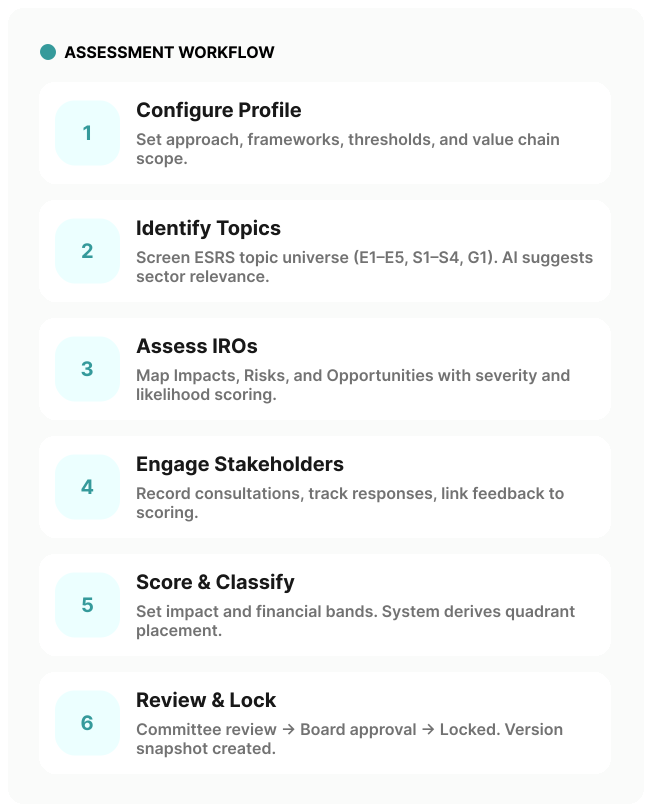
CSRD demands you assess each sustainability topic from two directions: its impact on people and planet, and its financial effect on your enterprise. SustainGRC scores both axes per topic, places them on the matrix, and records every decision with linked evidence.
Scale, scope, and irremediability of your outward effects on people and environment.
Risks and opportunities that could materially affect your cash flows, access to finance, or cost of capital.
Topics classified as Double Material, Impact Material, Financial Material, or Monitor — with configurable thresholds.
Stakeholder Engagement
ESRS requires you to demonstrate how stakeholder input shaped your materiality assessment. We make that link auditable.
Classify stakeholders as affected parties or users of reports per ESRS categories. Track contact counts and engagement methods.
Log every consultation — surveys, focus groups, town halls, board workshops — with sentiment tagging and topic linkage.
Connect stakeholder feedback directly to topic scoring. AI clusters sentiment by theme, but humans confirm every adjustment.
Assurance-ready documentation: who was engaged, when, how, and what changed as a result. Full separation of duties.
Each IRO carries tags showing which frameworks it satisfies. Data is collected once and mapped to all applicable standards.
Our AI suggests sector-relevant topics and clusters stakeholder sentiment, but never sets scores or classifies materiality. Every governance decision requires human confirmation with linked evidence.
Topics classified as material automatically propagate to ESG Reporting, Risk Management, and Strategic Planning — no re-entry required
Material topics determine which disclosures are in scope. Classification changes update coverage automatically.
Scope 1, 2, and 3 figures flow directly from the GHG Inventory module. No manual data transfer.
New regulation requirements auto-generate findings against your reporting configuration.
| Capability | SustainGRC | Point Tools |
|---|---|---|
| ESRS double materiality methodology | Partial | |
| IRO-level assessment (Impact, Risk, Opportunity) | ||
| Stakeholder engagement with topic linkage | ||
| Evidence lifecycle with separation of duties | ||
| Configurable thresholds and scoring bands | Manual | |
| Board-to-analyst governance workflow | Partial | |
| Cross-module propagation (Risk, Reporting) | ||
| AI-assisted topic and sentiment analysis | Partial | |
| Year-over-year comparison | ||
| LOCKED state immutability |
“We moved from a 4-month Excel exercise to a 6-week auditable process. The stakeholder traceability alone justified the investment.”
Head of Sustainability
FTSE 250 Financial Services · London