Ready to Operationalise Human Rights Due Diligence?
See how SustainGRC turns UNGP principles into auditable workflows — with CSDDD compliance, supply chain depth, and integrated grievance mechanism.
CSDDD is coming. UNGP expectations are rising. SustainGRC gives you systematic human rights due diligence — from salient issue identification through remediation to grievance mechanism — integrated into your GRC and supply chain stack.
How It Works
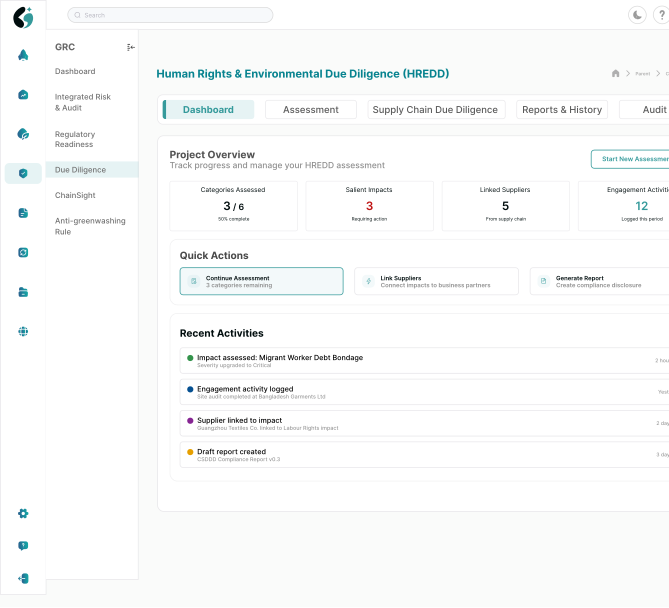
The UNGP process made operational — identify, assess, act, remedy, report — with governance at every stage.
Map your most severe human rights risks using industry benchmarks, stakeholder input, and AI-assisted prioritisation.
Run structured assessments across operations and supply chain. Questionnaires, audits, and country-level risk data combined.
Create corrective action plans with owners, timelines, and evidence. Monitor progress and verify effectiveness.
Generate CSDDD-ready reports, UNGC Communications on Progress, and framework-aligned disclosures with full audit trail.
Core Capabilities
Every UNGP pillar operationalised — with supply chain depth, grievance mechanism, and regulatory reporting built in.
Systematic identification and prioritisation of human rights issues most at risk of severe negative impacts — aligned to UNGP severity criteria.

Severity × Likelihood scoring
Industry-specific issue libraries
Stakeholder consultation tracking
Year-over-year comparison
Structured assessment questionnaires by category — labour rights, working conditions, community impacts, land rights, and digital rights.
Pre-built UNGP-aligned templates
Supplier self-assessment portal
On-site audit scheduling
Risk heat mapping
Corrective action plan (CAP) tracking with responsible owners, deadlines, evidence requirements, and effectiveness verification.
CAP creation and assignment
Milestone tracking
Evidence document linking
Effectiveness re-assessment
Integrated operational-level grievance mechanism meeting UNGP effectiveness criteria — accessible, predictable, equitable, transparent, and rights-compatible.
Multi-channel intake (web, phone, email)
Case tracking and resolution
Anonymity protection
Response time monitoring
Map human rights risks beyond Tier 1 — into raw material sourcing, sub-contractors, and informal supply chains where severe impacts concentrate.
Tier 1–3+ supplier mapping
Country risk scoring
Sector-specific indicators
Linked to Third-Party DD module
Pre-mapped disclosure outputs for CSDDD, UNGP Reporting Framework, GRI 407–414, UNGC Principles 1–6, and ESRS S1/S2.
CSDDD compliance tracker
GRI 407–414 auto-population
UNGC CoP evidence linking
ESRS S1/S2 narrative generation
UNGP Framework
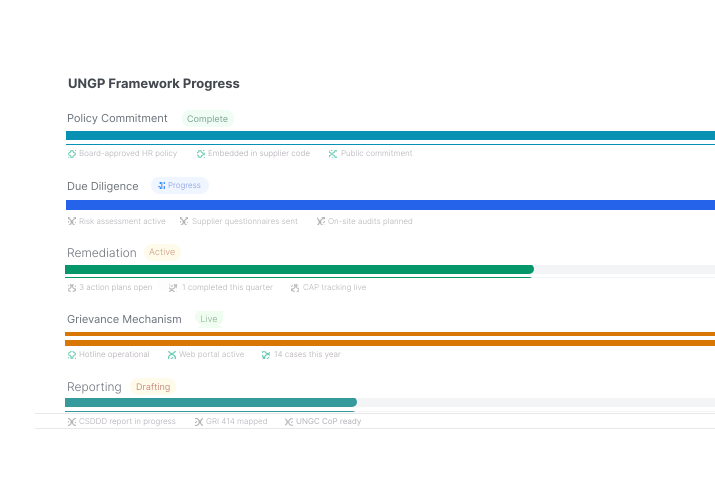
Track your progress across all five UNGP pillars — policy commitment, due diligence process, remediation, grievance mechanisms, and reporting — with evidence linking, gap identification, and board-level visibility.
Board-approved human rights policy with supply chain embedding
Not a one-off — continuous assessment with annual refresh cycles
Operational grievance mechanism meeting all 8 UNGP effectiveness criteria
Why SustainGRC
CSDDD demands substantive due diligence — not a questionnaire you send once a year. SustainGRC operationalises the full UNGP process with the depth regulators expect.
The EU Corporate Sustainability Due Diligence Directive requires systematic HRDD. SustainGRC is pre-mapped to every CSDDD obligation with gap tracking and compliance scoring.
Most platforms stop at direct suppliers. SustainGRC maps risks into Tier 2, 3, and raw material sourcing — where forced labour and child labour actually concentrate.
HRDD findings feed directly into ESG reporting, ERM, and third-party due diligence modules. No re-entry. No reconciliation. One audit trail.
AI suggests risk prioritisation and flags high-risk suppliers based on country, sector, and commodity indicators. Every recommendation requires human review.
Operational-level grievance mechanism built to UNGP effectiveness criteria — with case management, anonymity, and board-level reporting.
Operational-level grievance mechanism built to UNGP effectiveness criteria — with case management, anonymity, and board-level reporting.
Framework Coverage
Conduct your HRDD once. SustainGRC maps findings to every major human rights framework and regulatory requirement.
Platform Integration
HRDD findings flow into risk registers, ESG reports, and supplier governance — no re-entry, no reconciliation.
Supplier risk scores enriched with human rights data
GRI 407–414, ESRS S1/S2 auto-populated
Human rights risks in unified risk register
Grievance cases linked to incident response
See how SustainGRC turns UNGP principles into auditable workflows — with CSDDD compliance, supply chain depth, and integrated grievance mechanism.