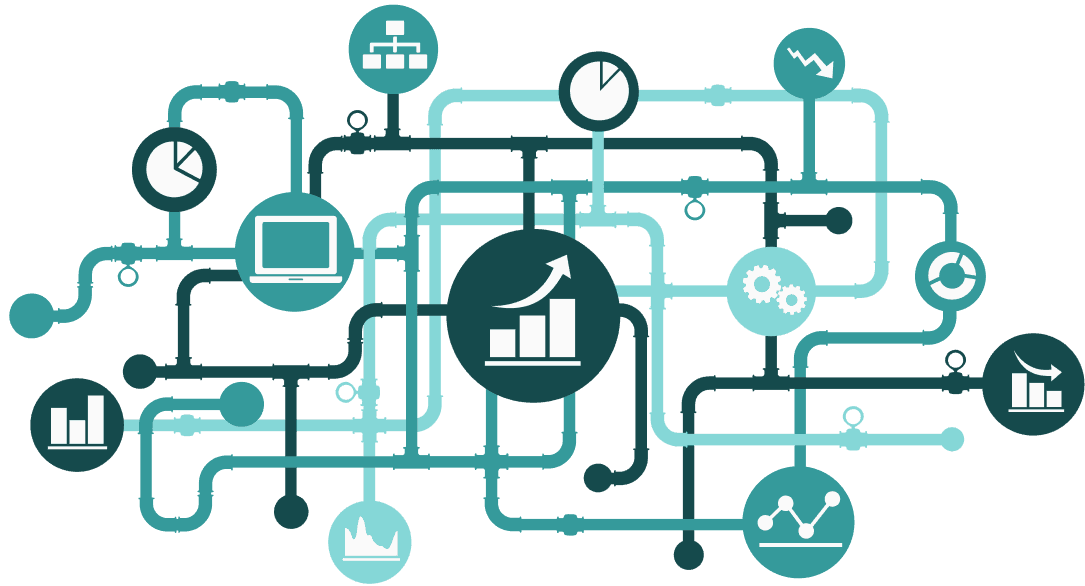
The Gulf is rewriting every rulebook at once. The answer isn’t more tools — it’s orchestration.
Across the GCC, climate, sustainability, AI, cyber, third-party and board governance obligations are arriving together — often in several markets at once. No organization answers that with another point tool. It needs one orchestrated model.
A regional executive team now opens the same quarter facing a climate-reporting mandate, an ISSB-aligned disclosure expectation, a cyber-resilience framework, an outsourcing and third-party rule, an AI charter and a tightened corporate-governance code — and, as often as not, in more than one market at once. Not one new rulebook. Most of them, arriving together.
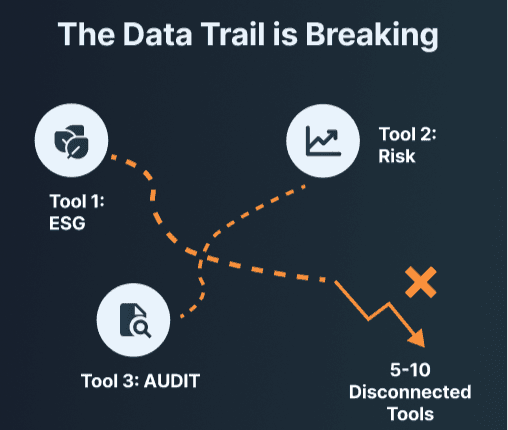
Here is the instinct that gets organizations into trouble. The natural move is to meet each obligation with its own project and its own tool: a carbon platform for the emissions law, a cyber product for the resilience framework, a register for third parties, a portal for the board, a bolt-on for AI. Six rulebooks, six tools. It feels orderly. It is the trap.
Convergence, not a queue
Europe received its non-financial transformation in installments, spread across more than a decade; firms could absorb one regime, then the next. The Gulf is compressing the same shift into a far shorter window and across several authorities at once — environment and climate authorities on emissions, with the UAE’s climate law the headline but not the only one; central banks and financial regulators bringing ISSB-aligned disclosure into force across the region; national cybersecurity bodies setting controls; and the DIFC and ADGM free zones layering their own expectations on top. Treating each as a standalone programme assumes they are separate problems. Underneath, they are asking about the same things.
It is the same data, asked six different ways
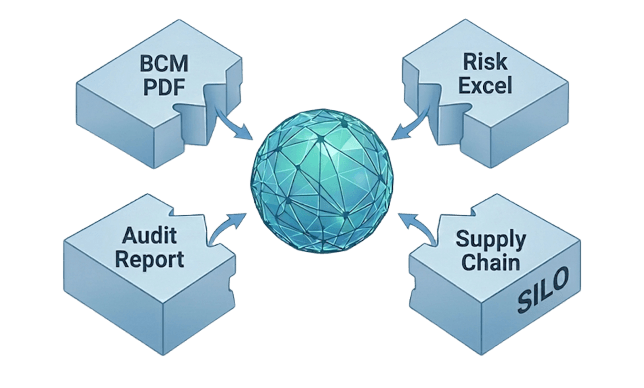
The emissions figure the climate regulator wants is the figure that feeds your sustainability disclosure. The supplier your outsourcing rule governs is the supplier in your cyber-concentration view and your operational-resilience map. The AI system your AI charter expects you to oversee is the one drafting your risk assessments. The board decision your governance code wants evidenced is the decision your audit trail should already hold. Capture each of those once and every regulator, in every market, is answerable from one place. Capture them six times, in six systems, and you spend the year reconciling — and still cannot put a connected picture in front of anyone who asks.
A stack of tools is a stack of seams
This is where the conventional approach quietly fails. A GRC tool here, an ESG and carbon tool there, a cyber platform, a third-party register, a board portal, an AI-governance add-on — six systems, six data models, six places the truth lives. The regulator’s question is rarely about one of them in isolation; it is almost always about how they connect. Does this supplier concentration threaten that important service? Does that AI system feed this disclosure? Was this board decision evidenced against that risk? Every one of those questions lands in the gap between two tools. Each integration you build to close the gap is another seam — and seams are exactly where assurance comes apart.
Orchestration is the architecture, not an add-on
Orchestration means something specific. It means one canonical model beneath every domain — governance, sustainability, risk, cyber, third-party, board and audit — so a data point is captured once and flows wherever it is needed, in the format each regime expects. The intelligence runs across the whole of it: AI proposes — it drafts the disclosure, flags the supplier, surfaces the control gap, reads the regulatory change — a named human confirms or overrides, and the system records both. This is not connecting six tools after the fact with enough middleware to paper over the seams. It is never having split them in the first place. That distinction is the difference between a regulator’s question you answer in minutes and one you spend a fortnight assembling.
One model beneath every domain. Collect once. Answer every regulator from one place.
Why it lands hardest in the Gulf
There is an advantage hidden in the pressure. These economies are building digital-first and moving at pace, with national strategies that treat governance and technology as instruments of ambition rather than overhead. There is less of the legacy GRC sediment that slows European firms — fewer entrenched systems to unpick. But the runway is shorter and the expectations are higher, which means the architecture decision cannot be deferred behind six procurement cycles. The organizations that treat this convergence as one design problem now — one orchestrated model across every domain — are the ones that will answer the regulator, and the board, without flinching. The rest will be reconciling spreadsheets when the question arrives.
The question for a Gulf board
So the question is not “which tool for which regulation.” That path is six procurement projects, six data models and a standing reconciliation problem. The question is simpler and harder: is our governance data orchestrated under one model, so that any regulator, in any market we operate in, can be answered from one place — today, not after a fortnight of assembly?
That is what SustainGRC was built to do — the intelligence infrastructure for non-financial data, with governance, sustainability, risk, cyber, third-party and board brought onto one orchestrated model, AI-native and human-governed throughout. One place to collect. One place to answer. Wherever the question comes from.